Saints of Divine Mercy University: Thérèse of Lisieux
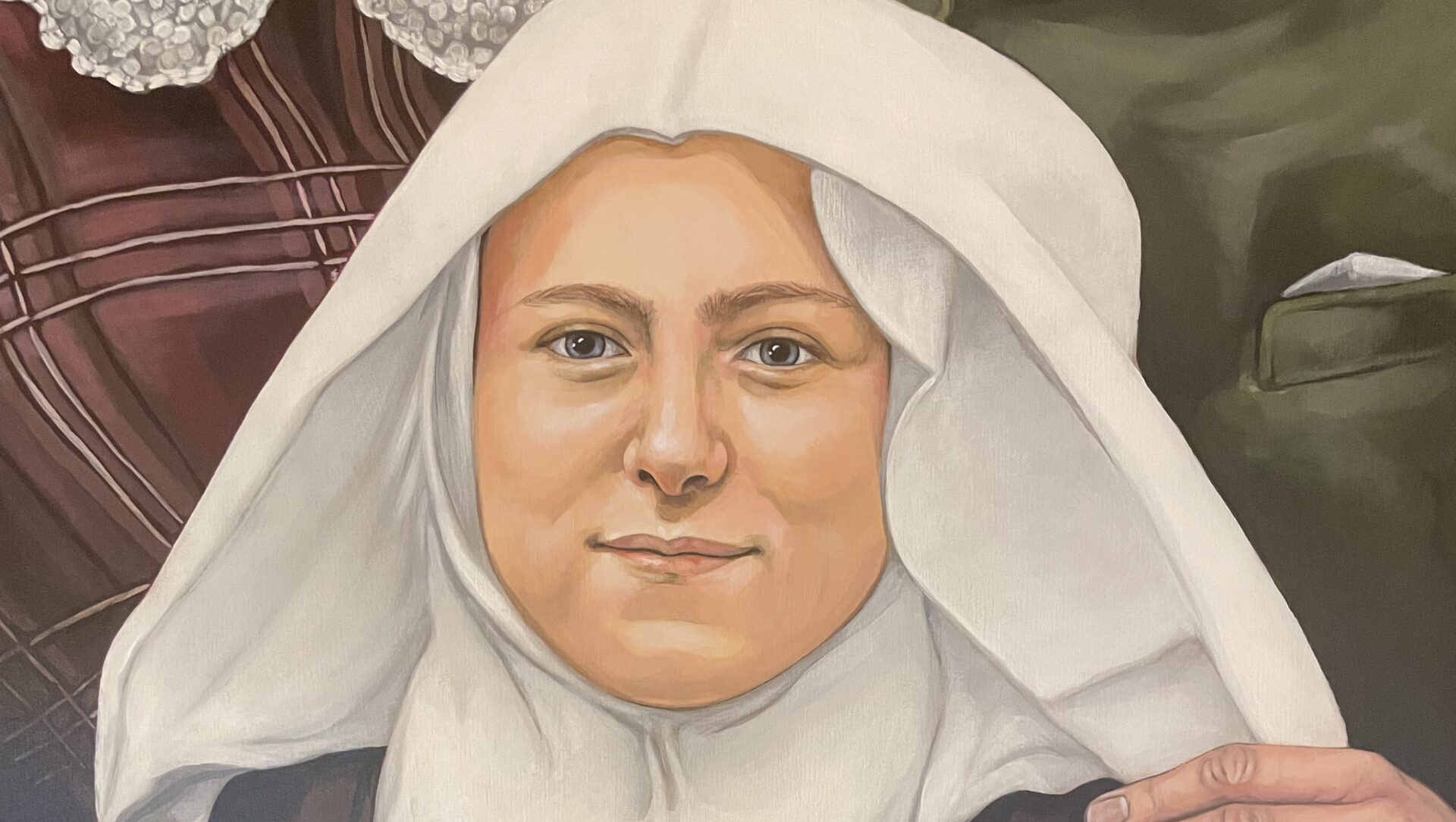
October 1 marks the feast day of Thérèse of Lisieux, also referred to as “The Little Flower.” She takes her place among Saints Dymphna, Mark Ji Tianxiang, Zélie and Louis Martin, Josephine Bakhita, Benedict Joseph Labre, and Faustina Kowalska as one of the patrons of Divine Mercy University and her students.
Thérèse was born January 2, 1873, in Alençon, France (Sanctuary of Lisieux, n.d.-b). She was the youngest child of Louis and Zélie Martin, of whom Thérèse wrote, two months before her own death, “God gave me a father and a mother more worthy of heaven than of earth” (Thérèse of Lisieux, 1897/n.d.-a). The couple instilled a great love for Jesus through their own example, rising before dawn to attend the morning Mass before the day’s labor.
Early Attachments
Throughout her early childhood, Thérèse suffered from a number of attachment injuries. Zélie had suffered since 1865 from a painful breast condition that would prove to be cancer. As a result she could not feed Thérèse (Sanctuary of Lisieux, n.d.-a). For this reason Thérèse was sent to a wet nurse, Rose Taillé, in the village of Semallé, seven kilometres from Alençon.(Archives of the Carmel of Lisieux, n.d.-a, n.d.-b).
To Rose she developed a deep attachment, and her own mother recorded what it cost to part them. Writing to Pauline in May 1873, Zélie described a visit home: “her wet nurse brought her, but she no longer wants to stay with us, and she lets out piercing screams when she no longer sees her wet nurse. So Louise had to carry her to the market, where ‘little Rose’ was selling her butter; there was no other way of managing it. As soon as she saw her wet nurse, she looked at her and laughed” (Martin, 1873/n.d.-a).
From April 1874 until she was four, Thérèse was cared for by her mother and was known to be both docile and ostensibly joyful and happy. However, her mother’s illness soon ran its course; Zélie died on August 28, 1877. Thérèse marks the period herself as extending “from the dawn of reason to the death of my dearly loved Mother; in other words, till I was four years and eight months old” (Thérèse of Lisieux, 1912/n.d.-b, Ch. I). Her death marked a notable change in Thérèse. She was sullen, sensitive, and prone to cry (Archives of the Carmel of Lisieux, 2023).
Her sister, Pauline, filled the role of a mother figure. She had been schooled at the Visitation Convent at Le Mans (Thérèse of Lisieux, 1912/n.d.-b, Ch. I), and it was natural that she tended to the child’s educational and emotional needs. Thérèse once told her she wished to go away with her to a far-off desert. Pauline answered that this was her wish too, but that she was waiting until Thérèse was big enough to set out. “This impossible promise,” Thérèse wrote, “I took in earnest” (Thérèse of Lisieux, 1912/n.d.-b, Ch. III).
In the summer of 1882, however, Thérèse overheard Pauline telling Marie that she would soon enter the Carmel. “I did not know the Carmel,” Thérèse wrote, “but I knew that she was leaving me to enter a convent, and that she would not wait for me” (Thérèse of Lisieux, 1912/n.d.-b, Ch. III). Pauline entered on October 2 of that year (Archives of the Carmel of Lisieux, 2023).
This third attachment rupture precipitated a mysterious illness, which began at Easter, March 25, 1883, and ran until Pentecost. She suffered hallucinations, tremors, and fits of fright, and could not be left alone (Archives of the Carmel of Lisieux, 2023; Society of the Little Flower, n.d.). Dr. Alphonse-Henri Notta, consulted at the request of her uncle Isidore Guérin, judged the illness very serious, expressly ruled out hysteria, yet could not name it. Her father feared she would die or lose her reason, and the she herself later wondered whether the devil had a hand in it (Archives of the Carmel of Lisieux, 2023).
Miraculous Healing
Her father asked Marie to write to the shrine of Notre-Dame des Victoires in Paris for a novena of Masses, and the family statue of Our Lady of the Smile was brought into Thérèse’s room (O’Riordan, n.d.).
On Pentecost Sunday, May 13, 1883, Marie had gone out into the garden, leaving Thérèse with Léonie, who was reading. Thérèse began to call for “Maman.” Hearing Thérèse calling out, Marie came to her but Thérèse did not recognize her. Marie knelt by the bed with Céline and Léonie, praying before the statue. Thérèse, too, turned toward the image of Our Lady and prayed (O’Riordan, n.d.). “All of a sudden,” she wrote, “the Blessed Virgin appeared beautiful to me… what penetrated to the very depths of my soul was the ravishing smile of the Blessed Virgin” (as quoted in O’Riordan, n.d.). The vision lasted four or five minutes. The illness lifted.
Read through the lens of attachment, the pattern is stark: by the time she was ten, Thérèse had lost the three women she had taken as mothers. A psychiatrist writing for the Carmel of Lisieux’s own archives diagnoses the episode as post-traumatic stress with a dissociative crisis, arising from an unmourned maternal death reactivated by Pauline’s departure (Archives of the Carmel of Lisieux, 2023).
In the absence of any treatment that could assist her, God’s grace, mediated through Our Lady, was the means of her restoration. Though she would continue to struggle with other attachments throughout her life, this episode marks the healing of a child who was languishing and near death in the throes of a psychological malady.
Lasting Legacy
Thérèse would soon join her sisters in Carmel, paying special attention to remain firmly rooted in her attachment to Christ and Our Lady rather than substitute relationships. Her autobiography, written at the direction of her superior (who was also her sister Pauline, by then Mother Agnès of Jesus ) documents the profound interior life of a young woman who, though incapable of great external conquests, was nevertheless capable of great love (Archives of the Carmel of Lisieux, 2023).
Though mental health healings will not often or likely present themselves in the astonishing manner of the Little Flower, her life reminds us of the necessity to allow space for the Divine Physician to work alongside the care we give.
Thérèse of the Child Jesus,
Pray for Us!
References
Archives of the Carmel of Lisieux. (n.d.-a). Taillé, Rose, Madame [Person record]. https://archives.carmeldelisieux.fr/personnage/taille-rose-madame/
Archives of the Carmel of Lisieux. (n.d.-b). Semallé [Place record]. https://archives.carmeldelisieux.fr/lieux/semalle/
Archives of the Carmel of Lisieux. (2023). A strange illness: Thérèse’s illness at the age of 10, from Easter to Pentecost 1883 (M.-D. Fouqueray, Contributor). https://archives.carmeldelisieux.fr/en/la-vie-de-sainte-therese-de-lisieux/la-maladie-de-therese-a-10-ans/le-mot-de-la-psychiatre/
Martin, Z. (n.d.-a). De Mme Martin à sa fille Pauline, CF 102 — 22 mai 1873 [Letter]. Archives du Carmel de Lisieux. https://archives.carmeldelisieux.fr/correspondance/de-mme-martin-a-sa-fille-pauline-cf-102-22-mai-1873/ (Original work written 1873)
Martin, Z. (n.d.-b). De Mme Martin à sa fille Pauline, CF 104 — 1er juillet 1873 [Letter]. Archives du Carmel de Lisieux. https://archives.carmeldelisieux.fr/correspondance/de-mme-martin-a-sa-fille-pauline-cf-104-1er-juillet-1873/ (Original work written 1873)
O’Riordan, M. (n.d.). The Blessed Virgin cures Thérèse at age ten. Saint Thérèse of Lisieux. http://www.thereseoflisieux.org/the-blessed-virgin-cures-there/
Sanctuary of Lisieux. (n.d.-a). The story of Louis and Zélie. Basilica of Saint Thérèse. https://www.therese-de-lisieux.catholique.fr/en/lhistoire/histoire-louis-zelie/
Sanctuary of Lisieux. (n.d.-b). The story of Thérèse. Basilica of Saint Thérèse. https://www.therese-de-lisieux.catholique.fr/en/lhistoire/lhistoire-de-therese/
Society of the Little Flower. (n.d.). The healing of Our Lady of the Smile. https://www.littleflower.org/therese-facts/the-healing-of-our-lady-of-the-smile/
Thérèse of Lisieux. (n.d.-a). LT 261 — À l’abbé Bellière — 26 juillet 1897 [Letter]. Archives du Carmel de Lisieux. https://archives.carmeldelisieux.fr/correspondance/lt-261-a-labbe-belliere-26-juillet-1897/ (Original work written 1897)
Thérèse of Lisieux. (n.d.-b). Story of a soul: The autobiography of St. Thérèse of Lisieux (T. N. Taylor, Ed. & Trans.). My Catholic Life. https://mycatholic.life/books/story-soul-saint-therese-lisieux/ (Original work published 1898; translation published 1912)